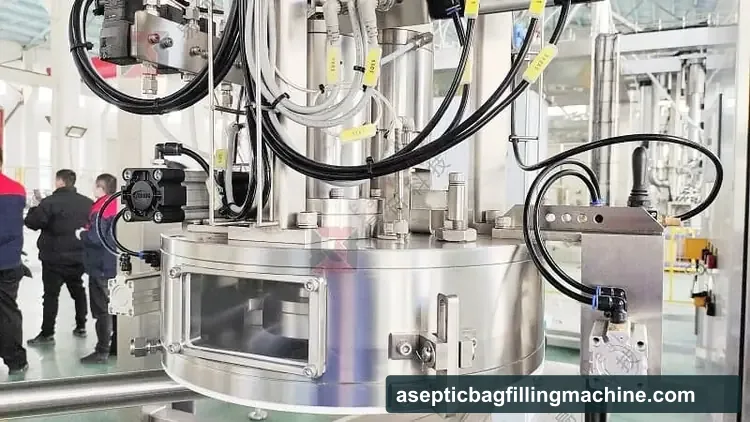
Define the product at the filling condition
Record the concentration or Brix, formulation and filling temperature. Measure viscosity under a stated method and shear rate, and state whether the value changes across the production range. For paste, purée or sauce, describe yield stress, fibre and particles. A single room-temperature viscosity figure can hide a much higher resistance at the filler inlet or during the final filling phase.
Transfer is part of the filling system
Review the pump, pipe diameter, bends, valves and filling head as one passage. Pressure loss rises with viscosity and flow, and a pump that suits water may damage a shear-sensitive purée or fail to deliver the required inlet pressure. Confirm the minimum inlet pressure at the filler, the response to a head stop, and the product velocity that the process can tolerate. The upstream sterilizer or buffer must support the same flow without exceeding the allowed holding time.
Valve path and final fill control
A high-viscosity product needs a valve and head passage that can pass it without excessive pressure or blockage. The final filling phase, cut-off response and any drip or stringing affect the net fill and the package interface. For fibrous or particulate products, the smallest restriction may be outside the filling head, in a valve seat or fitment. Ask for the actual passage dimensions and a trial with the production product, not a water test.
Weighing or flow measurement
Weighing measures the filled package and is often easier to connect to the commercial net-mass target. A flow meter can work when the product and flow are stable, but density and viscosity changes affect the stop response. Catalogue references such as ±5 g resolution or ±0.3% meter accuracy are component figures; the accepted finished-package result must be established with your product, package and sampling plan.
Package support, closure and cleaning
A 200 L drum or 1000 L bin carries the filled mass; the bag neck and fitment must not carry it. Confirm the liner support, head reach, weighing platform and filled-container movement together. Residues are harder to remove from a viscous product, so map the CIP circuit, dead spaces, drain points and manually cleaned parts. The filler protects the aseptic interface and closes the package; it does not sterilise the product.
EQUIPMENT TO COMPARE
Machines that fit this selection.
AF1S single-head bag-in-drum filler
A single filling position for 200 L class aseptic bags in drums. The AF1S is the reference model when one head, one drum station and a straightforward load–fill–close cycle fit your production window.
Review the model ↗AF1DAF1D twin-head bag-in-drum filler
Two filling positions for 200 L class aseptic bags. The AF1D is the reference model when drum handling can overlap and the product supply, conveyors and operator access can support two stations.
Review the model ↗Bulk format1000 L aseptic bulk bag filling machine
Bulk bags change the scale of every interface: head reach, liner support, filled load, weighing, container movement and the time needed to fill one package.
Review the model ↗PRACTICAL ANSWERS
Frequently asked questions
Can a standard juice filler handle tomato paste?
Not without checking the product at its filling condition, the pump and pipe pressure loss, the valve and head passage, the metering response and the cleaning circuit. A juice capacity figure does not establish paste compatibility.
Which metering method is better for viscous products?
Weighing is often easier to connect to a net-mass target, while a flow meter can work when the flow and density are stable. The right choice depends on the product, fill mass and acceptance method, and should be proven with a representative trial.
Does a larger bag mouth solve a viscous filling problem?
It may reduce one restriction, but the pump, pipe, valve, head and fitment all form the passage. Increasing only the mouth diameter can leave the real bottleneck elsewhere.
Does the filler sterilise the paste?
No. Product sterilisation is an upstream process. The filler receives treated product, protects the interface and manages filling and closure.