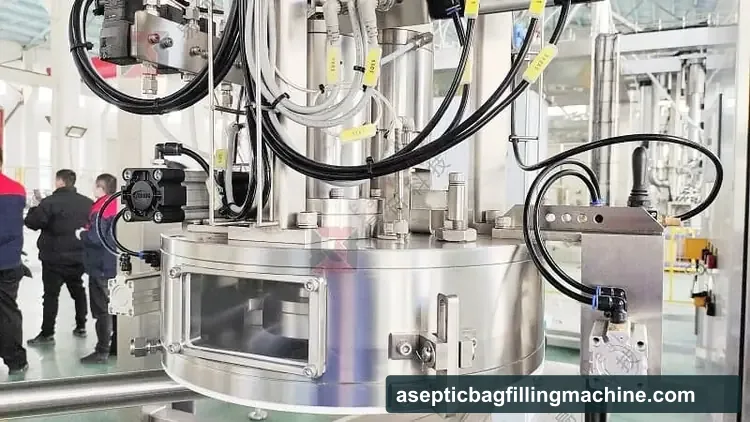
Identify the equipment and test boundary
Record machine and software revisions, head arrangement, metering method, conveyor/support and the exact bag, neck and cap used. State whether the factory test includes the upstream sterilizer, sterile buffer or only a simulated inlet. A photograph of an assembled cell does not establish those interfaces.
Check the full package cycle
Time loading, head connection, filling, closure and unloading for the agreed product and package. Record how a second head shares product supply and operator tasks. Compare sustained finished packages against a declared test window, including stops and changeovers.
Keep net-fill evidence separate from sensor resolution
Agree the weighing reference, sampling method, tare treatment, target and acceptance limits. Retain individual results and the equipment verification reference. A scale display resolution or a flowmeter catalogue accuracy is not a completed net-fill acceptance test.
Review interrupted operation
Use the agreed safe test procedure to review loss of product supply, utility, verification signal or package engagement. Record the resulting state, permitted recovery and who authorizes restart. Link deviations to the relevant test case instead of removing them from the summary.
Add the site-specific checks at SAT
Verify actual utility conditions, upstream/downstream connections, container movement, drainage and plant controls. Reference cleaning/interface-treatment records and the plant process-validation responsibility. A factory water test does not establish the sterile process for the installed food product.
EQUIPMENT TO COMPARE
Machines that fit this selection.
AF1S single-head bag-in-drum filler
A single filling position for 200 L class aseptic bags in drums. The AF1S is the reference model when one head, one drum station and a straightforward load–fill–close cycle fit your production window.
Review the model ↗AF2SAF2S single-head bag-in-box filler
A compact single-head model for 1–25 L aseptic bags in boxes. The AF2S is the starting point when retail and food-service pack sizes, quick changeovers and a small footprint matter more than bulk drum output.
Review the model ↗AF1DAF1D twin-head bag-in-drum filler
Two filling positions for 200 L class aseptic bags. The AF1D is the reference model when drum handling can overlap and the product supply, conveyors and operator access can support two stations.
Review the model ↗PRACTICAL ANSWERS
Frequently asked questions
Does a signed FAT prove a validated aseptic food process?
No. FAT addresses the agreed equipment and test boundary. The installed process, product, packaging and release responsibilities need their own evidence.
Can the blank checklist be used as an acceptance certificate?
It is a record template. It becomes evidence only when agreed criteria, actual results, raw references and responsible review have been completed.