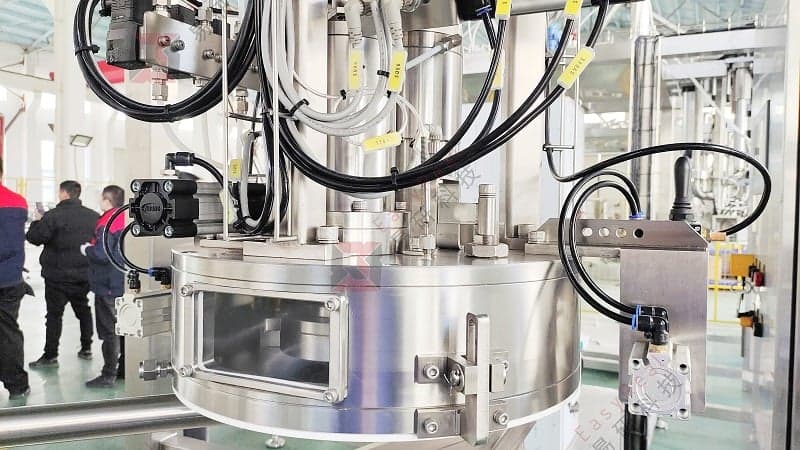
Define the sterile transfer
The UHT outlet, holding tube, cooler and transfer line to the filler form the sterile path. The filler inlet needs a defined temperature, pressure and flow window. Materials, joints, valves and instruments in the path must be suitable for the process and cleaning. The responsibility boundary between the UHT supplier and the filler supplier should be documented.
Buffer and flow matching
The UHT may run continuously while the filler stops between bags or containers. A buffer can decouple the two, but it adds volume and holding time. Size the buffer from the filler demand, the UHT response and the acceptable product holding time. Do not use the filler as an uncontrolled buffer.
Start, stop and deviation logic
Define what happens when the filler stops, a bag fails, the downstream conveyor blocks or the UHT deviates. The response may include recirculation, diversion, isolation or a controlled shutdown. The product already in the sterile path must be handled according to the process design. The control handover should be tested at FAT and SAT.
CIP and SIP across the boundary
Cleaning and sterilisation may cover the UHT, transfer line and filler as separate circuits or as a combined sequence. Map the valves, returns, vents and sampling points. Confirm who verifies each circuit and how the line is released for production. The filler's CIP/SIP scope may not include the entire upstream path.
EQUIPMENT TO COMPARE
Machines that fit this selection.
AF1D twin-head bag-in-drum filler
Two filling positions for 200 L class aseptic bags. The AF1D is the reference model when drum handling can overlap and the product supply, conveyors and operator access can support two stations.
Review the model ↗AutomationHigh-capacity aseptic bag filling system
High capacity is a system property. The filler, upstream supply, drum or bin logistics, weighing and cleaning must be designed for the same sustained rate.
Review the model ↗PRACTICAL ANSWERS
Frequently asked questions
Can I use an existing UHT with a new filler?
It may be possible, but the sterile transfer, flow, pressure, temperature and control handover must be reviewed. The existing UHT documentation and condition are part of the assessment.
Who is responsible for the sterile boundary?
Responsibility is shared across the UHT, transfer line, filler and package. It should be defined in the project specification and verified at the interfaces, not assumed from a single equipment supplier.
Do I need a buffer tank?
A buffer can help decouple the UHT and filler, but it adds holding time and cleaning scope. Size it from the actual stop frequency, flow and acceptable product holding time.