A 200 L drum is a package system, not just a container. The liner, fitment, drum, weighing platform and conveyor determine whether the filling cell works.
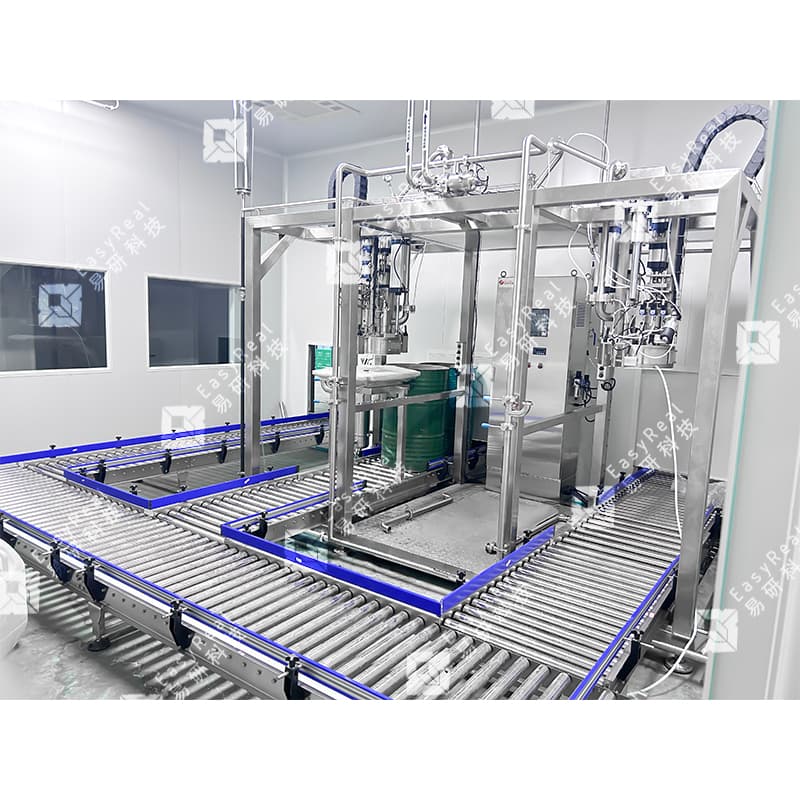
Twin-head filling installation. Original equipment photograph, AI-retouched environment; source easireal.com.Photograph supplied by the equipment manufacturer.
A 200 L aseptic drum filling machine fills a pre-sterilised flexible bag inside a drum, closes the bag and hands the filled drum to storage or dispatch. The drum supports the bag, but the bag neck and fitment carry the aseptic connection.
The difference between a workable cell and a difficult one is often the drum handling: how the empty drum arrives, how the liner is positioned, how the fitment is presented, how the filled mass is measured and how the drum leaves without disturbing the closure.
Package200 L bag-in-drum
ModelsAF1S / AF1D
MeteringWeighing or flow
Fitment1 in / 2 in
01
Drum, liner and fitment
Record the drum diameter, height, tare mass and pallet arrangement. Confirm the liner supplier, bag drawing, fitment part number and cap revision. The head must engage the fitment without loading the bag neck, and the drum must be stable during filling.
A 200 L nominal volume does not define the working fill. The product density, target net mass, ullage and bag dimensions determine the actual fill. Confirm the filled mass and the centre of gravity before specifying the conveyor and floor loading.
The AF1S single-head model is the simpler choice when one drum position meets the production window. The AF1D adds a second position for overlapping handling, with a published family maximum of up to 12 t/h.
Compare the complete drum cycle: load, fitment connection, fill, close, inspect and discharge. If the drum movement or operator work is the bottleneck, a second head may not add the output you expect.
A weighing platform measures the drum and product together; the tare must be established for the drum, liner and any support. A flow meter measures product passing the meter and needs a representative density and a stable stop sequence. Both need a defined acceptance sample and tolerance.
The roller conveyor should present the drum at the correct height, stop it positively and allow the filled drum to leave without a jolt. Confirm the load rating, guarding and access for cleaning. For multi-position layouts, plan the traffic flow before fixing the footprint.
The filler protects the bag interface and closes the package. Product sterilisation is upstream. Confirm the CIP circuit for the product path and the steam sterilisation sequence for the filling head, including the criteria for restart after a stop.
After filling, the drum should be staged and stored under conditions that protect the bag and fitment. The filler does not establish shelf life; the product process, package barrier, closure integrity and storage conditions do.
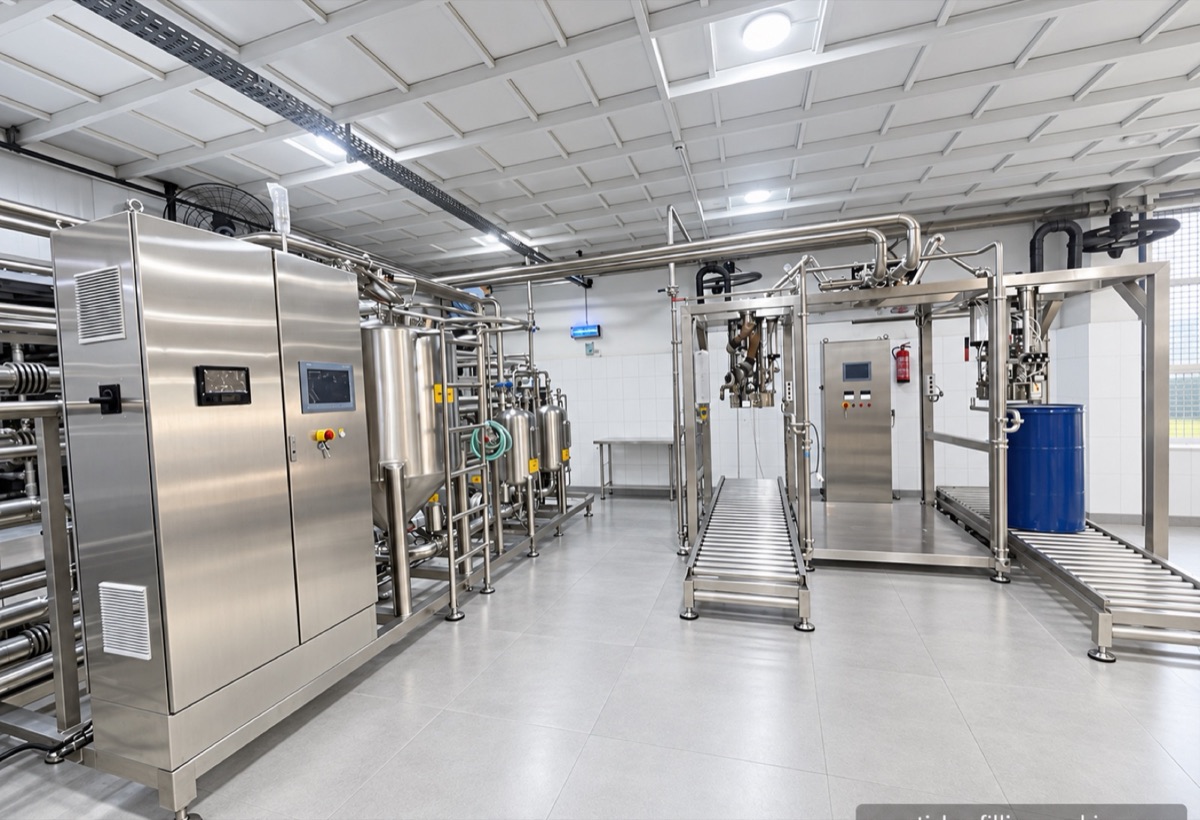
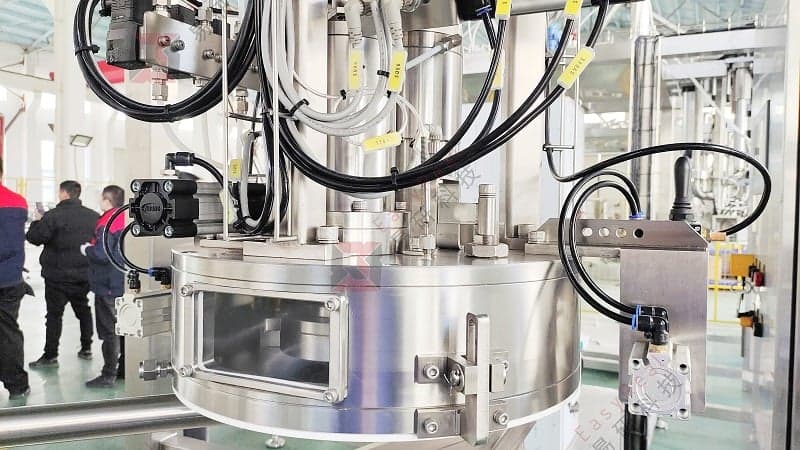
Manufacturer photographs show the filling head, drum or container handling and the connected cell. Final configuration, guarding and finish depend on the project.
What the catalogue confirms — and what it does not.
Use these values to frame the enquiry. The offered specification, drawing and acceptance test govern the actual machine.
200 L aseptic drum filling machine — published catalogue and configuration reference
Typical bag size
200 L / 220 L
Reference models
AF1S single head · AF1D twin head
Published maximum
up to 6 t/h single · up to 12 t/h twin
Metering
Weighing system or flow meter
Fitment
1 in and 2 in (25 mm / 50 mm)
Drum handling
Roller conveyor, stops and weighing platformLayout-specific
Steam
approx. 50 kg/h single · 100 kg/h twin
Air
approx. 0.04 m³/h single · 0.06 m³/h twin
Filling interface
Steam-sterilised head; CIP/SIP integrated
Dimensions
Confirm with the drum and layout drawing
Source: EasyReal AF-series aseptic bag filling catalogue. Catalogue values checked 22 October 2026. They are reference maxima for the model family, not a guarantee for a particular product, bag or line. Final model, scope and performance are confirmed in the offered specification.
PRODUCT FIT
Applications to review with this equipment.
Product names are a starting point. Viscosity, particles, temperature and the package interface determine whether a trial is needed.
It is a filling cell that fills a pre-sterilised bag inside a 200 L drum, closes the bag and discharges the drum. The drum supports the bag; the filling head and fitment maintain the protected interface.
Can it fill 220 L bags?
The AF1 catalogue lists 200 L and 220 L bag sizes. Confirm the exact bag, drum and fitment, because the working combination may differ from the nominal size.
Is weighing better than a flow meter for drums?
Weighing directly measures the filled mass and is often easier to connect to the commercial fill target. A flow meter can be suitable when the product and flow are stable. The choice should be confirmed with a trial and a defined acceptance method.
Does the drum need a liner?
Aseptic bag-in-drum filling uses a pre-sterilised bag/liner as the product-contact package. The drum is the outer support. Confirm the bag and fitment specification with your packaging supplier.
Send the product, bag or container, target net mass, output and site conditions. We will confirm the model, scope and evidence needed for the next step.