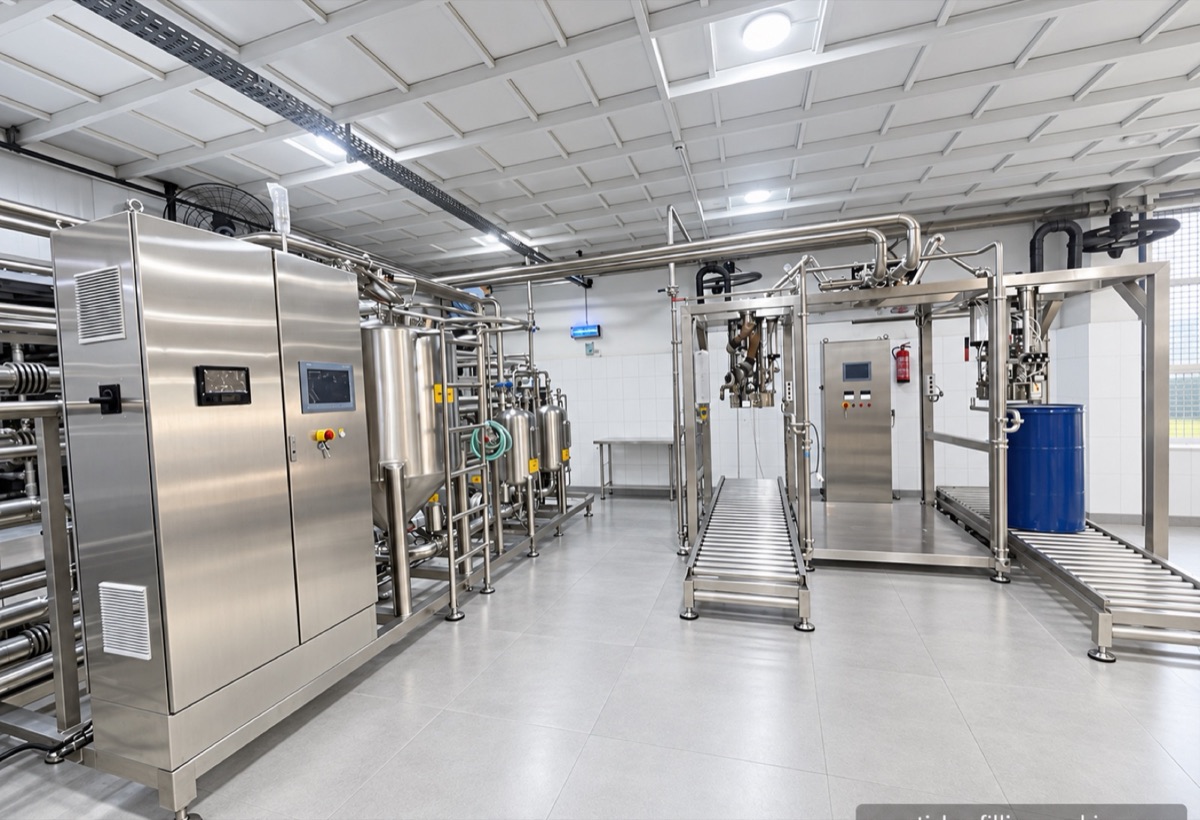
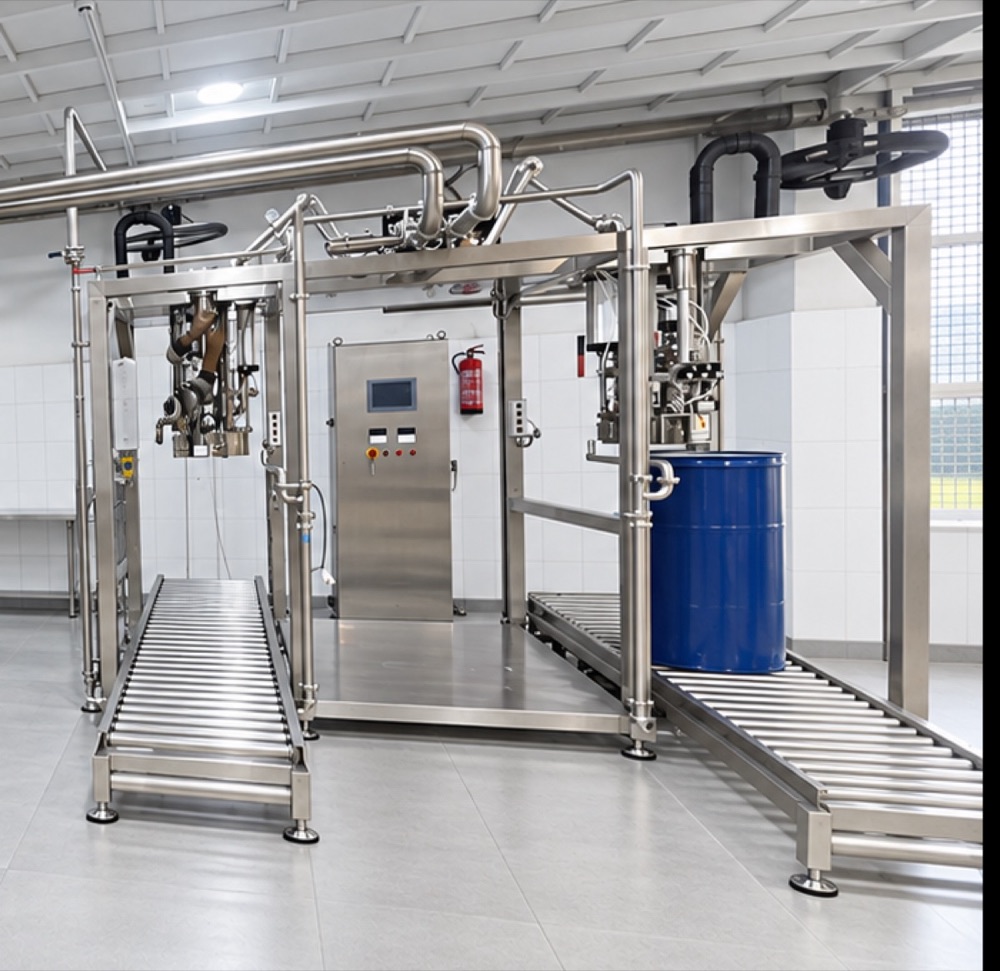
Two filling positions for 200 L class aseptic bags. The AF1D is the reference model when drum handling can overlap and the product supply, conveyors and operator access can support two stations.
Twin-head filling installation. Original equipment photograph, AI-retouched environment; source easireal.com.Photograph supplied by the equipment manufacturer.
The AF1D adds a second filling position to the bag-in-drum platform. The useful question is not simply whether two heads double output; it is which steps can overlap. Drum presentation, fitment connection, filling, closure inspection and discharge all occupy the cell.
A twin-head layout can improve output when the conveyors, product supply, weighing and operator work are designed around two stations. It can also create congestion if the drums, guards and service access are treated as an afterthought.
ModelAF1D
HeadsTwin
PackageBag-in-drum, 200–220 L
Published max.up to 12 t/h
01
What the second head changes
The AF1D can fill one drum while the other position is prepared or discharged, provided the actual control sequence and handling layout allow it. Confirm whether the heads fill simultaneously or alternate, and whether they share product supply, cleaning circuits and weighing hardware.
The published maximum is up to 12 t/h for the model family, with 2 kW installed power. That is a catalogue reference, not a guaranteed rate for a viscous paste or a difficult fitment. Ask for a cycle breakdown with your product and drum.
Two heads need two clear drum positions, a safe operator zone and a discharge route that does not block the next load. The roller conveyor, stops, weighing platforms and guards must be laid out together. Confirm maintenance access to both heads and the space needed to change fitment parts.
If drums arrive on pallets, define how they are transferred to the filling station and where the filled drum is staged. The filled mass and floor loading may govern the conveyor specification.
A second head increases instantaneous product demand when both positions fill. Confirm the upstream sterilizer, buffer and pump can deliver the required flow at the agreed inlet pressure without starving either head. The response to a head stop or a lost upstream condition must be defined.
Weighing and flow-meter options are both listed for the AF1 family. With two heads, the tare routine, scale assignment and acceptance sampling need to be unambiguous. Do not assume that a single-head accuracy result applies unchanged to both positions.
Catalogue reference utilities for the twin-head model are approximately 100 kg/h steam and 0.06 m³/h compressed air at 0.6–0.8 MPa. The final demand schedule depends on the cleaning and sterilisation sequence and must be confirmed in the proposal.
Factory acceptance should cover both heads, the change parts, the closure sequence and the control handover. Site acceptance should repeat the critical checks with the actual product, bag and drum, including net fill and package integrity.
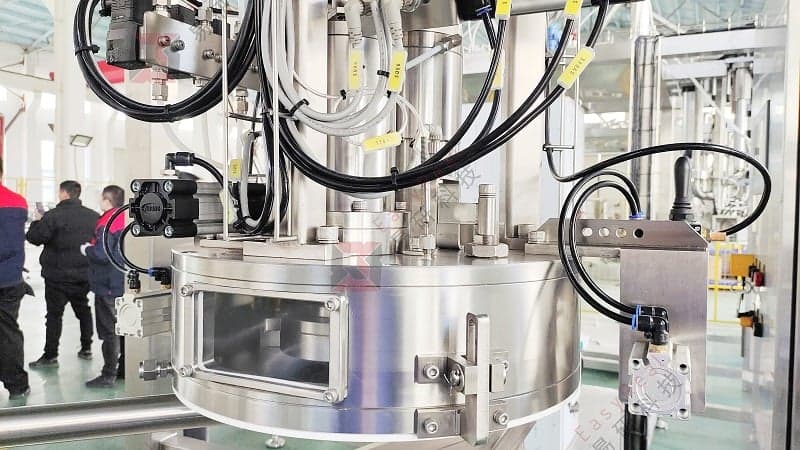
Manufacturer photographs show the filling head, drum or container handling and the connected cell. Final configuration, guarding and finish depend on the project.
Twin-head filling installation. Original equipment photograph, AI-retouched environment; source easireal.com.Close view of the filling station. Original equipment photograph, AI-retouched environment; source easireal.com.Filling-head close-up. Equipment photograph: EasyReal AF-series, source easireal.com.
SPECIFICATION REFERENCE
What the catalogue confirms — and what it does not.
Use these values to frame the enquiry. The offered specification, drawing and acceptance test govern the actual machine.
AF1D twin-head bag-in-drum filler — published catalogue and configuration reference
Model
AF1D
Filling heads
Twin head
Bag format
Bag-in-drum (BID)
Bag size
200 L / 220 L
Published maximum throughput
up to 12 t/h
Installed power
2 kW
Metering
Weighing system or flow meter
Bag mouth / fitment
1 in and 2 in (25 mm / 50 mm)
Steam
approx. 100 kg/h at 0.6–0.8 MPa
Compressed air
approx. 0.06 m³/h at 0.6–0.8 MPa
Filling interface
Steam-sterilised filling head; CIP/SIP integrated
Dimensions and weight
Not published in the catalogue — confirm with the layout drawing
Net-fill accuracy
Catalogue reference: weighing ±5 g; flow meter ±0.3%
Source: EasyReal AF-series aseptic bag filling catalogue. Catalogue values checked 22 October 2026. They are reference maxima for the model family, not a guarantee for a particular product, bag or line. Final model, scope and performance are confirmed in the offered specification.
PRODUCT FIT
Applications to review with this equipment.
Product names are a starting point. Viscosity, particles, temperature and the package interface determine whether a trial is needed.
Not automatically. The catalogue maximum rises from up to 6 t/h to up to 12 t/h for the model family, but shared product supply, drum handling, operator work and cleaning can limit the complete drum rate. Compare a full cycle with your product.
Can both heads fill at the same time?
The control sequence and product supply determine whether the heads fill simultaneously or alternate. Confirm the proposed logic and the upstream response before fixing the layout.
What utilities does the twin-head model need?
The catalogue reference is approximately 100 kg/h steam and 0.06 m³/h compressed air at 0.6–0.8 MPa. Final figures depend on the cleaning and sterilisation sequence and must be confirmed for the offered configuration.
Is the AF1D suitable for tomato paste?
The AF1 family is used for bag-in-drum food products including pastes and purées, but suitability must be checked against your Brix, viscosity, temperature, fitment and target cycle. A representative trial is the correct basis.
Send the product, bag or container, target net mass, output and site conditions. We will confirm the model, scope and evidence needed for the next step.