High capacity is a system property. The filler, upstream supply, drum or bin logistics, weighing and cleaning must be designed for the same sustained rate.
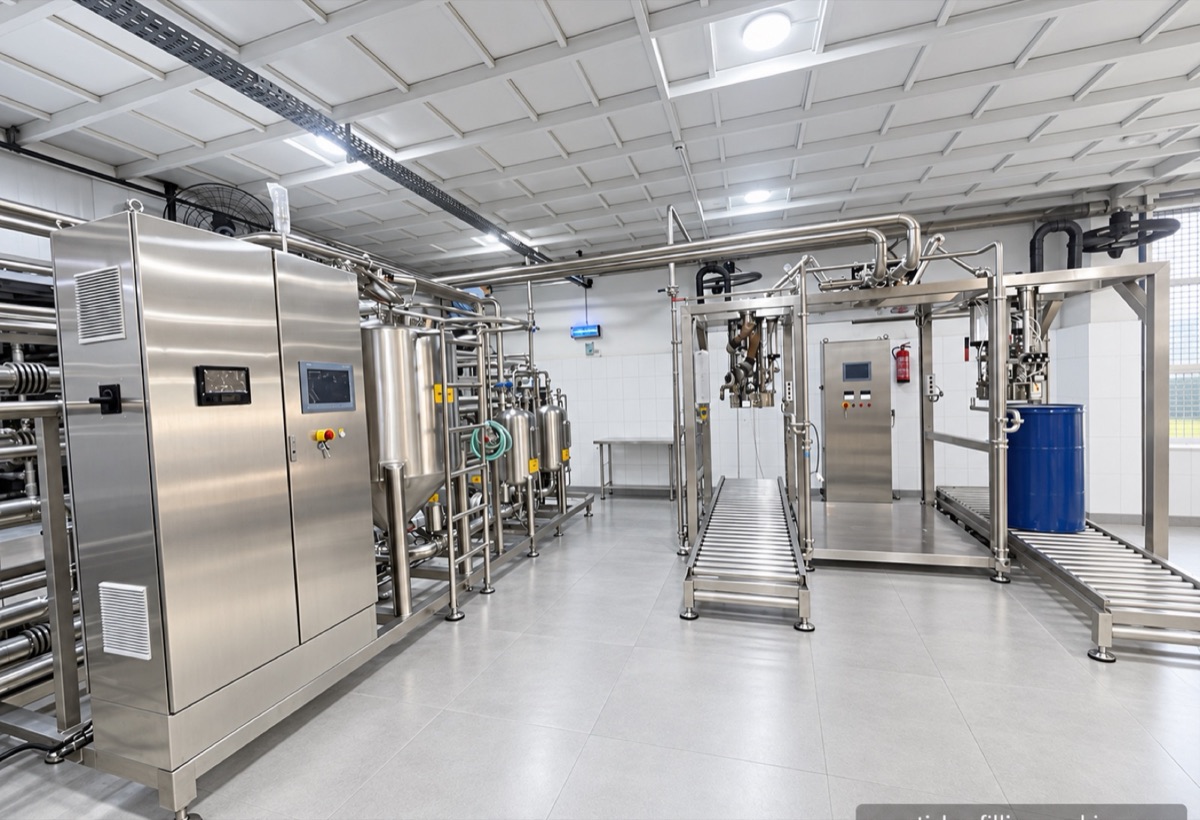
Twin-head filling installation. Original equipment photograph, AI-retouched environment; source easireal.com.Photograph supplied by the equipment manufacturer.
A high-capacity aseptic bag filling system usually combines twin filling heads, powered or gravity roller conveyors, a buffer for treated product and a cleaning/sterilisation sequence that fits the production window. The filler is one part of the sustained rate.
The catalogue AF1D and AF4 families reach up to 12 t/h as published maxima. A real line may be limited by upstream supply, drum or bin movement, weighing time, closure inspection or the number of operators. The system design should expose those limits before the equipment is fixed.
PlatformAF1D / AF4
FormatsBID · BIC
Published max.up to 12 t/h
HandlingConveyor-based
01
Start with the sustained rate
Calculate the required rate from the finished packages per shift, not from a peak filling figure. Include cleaning, pre-sterilisation, changeover, breaks and planned stops. Then check whether the upstream sterilizer and buffer can deliver product at the filler inlet for the whole window.
If the line runs at 12 t/h for only part of the day, a smaller filler with more buffer may be more economic. If it must sustain 12 t/h, the conveyors and product supply need to be designed for that rate, not sized around a single head.
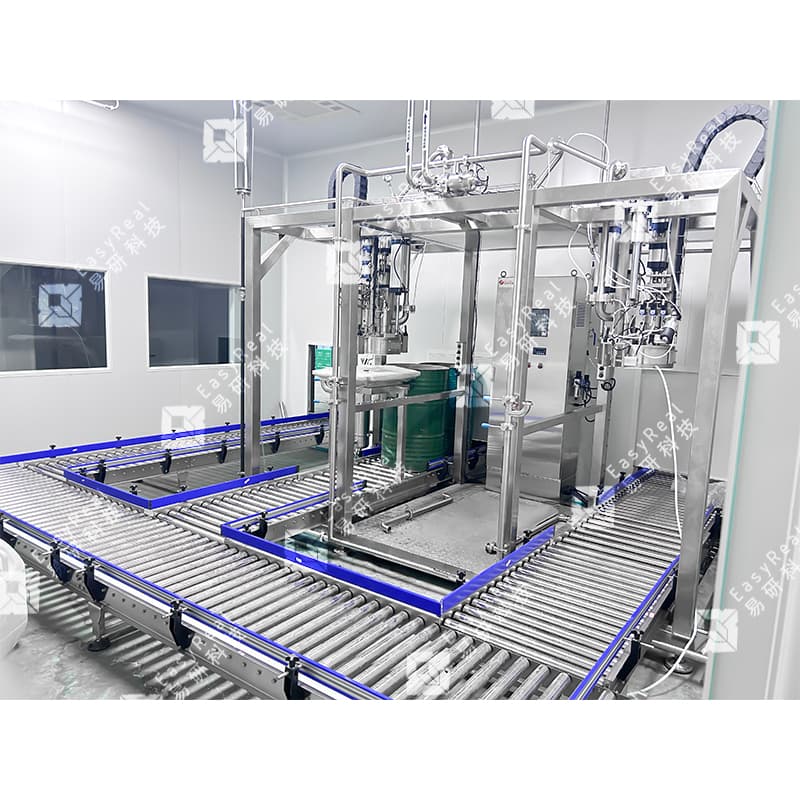
Two heads can overlap filling with drum or bin exchange, but only if the conveyor has enough positions and the traffic flow is one-way. Plan empty-container staging, filling positions, closure inspection and filled-container accumulation. Avoid a layout where a filled drum must be moved through the next filling position.
For 1000 L and 1500 L bulk bags, the container, liner and filled mass change the conveyor, floor loading and lifting requirements. Confirm the filled load and the movement method before selecting the conveyor.
A high-capacity filler needs a stable inlet pressure and flow. The upstream sterilizer, holding tube, cooler and buffer should be matched to the filler’s demand and response time. Define what happens when a head stops, a bag fails or the downstream conveyor blocks.
Do not use the filler as the buffer. Product held in the sterile path for too long may change quality, and repeated stops may compromise the process. The line control philosophy should be agreed before the equipment schedule.
High-capacity operation increases the cost of every cleaning stop, so the CIP/SIP sequence should be designed for fast, verifiable coverage. Confirm the circuits, return paths, sampling points and the criteria for restart.
The catalogue reference for a twin-head AF1D is approximately 100 kg/h steam and 0.06 m³/h compressed air at 0.6–0.8 MPa. A larger AF4 configuration has a different demand; obtain the schedule for the actual model.
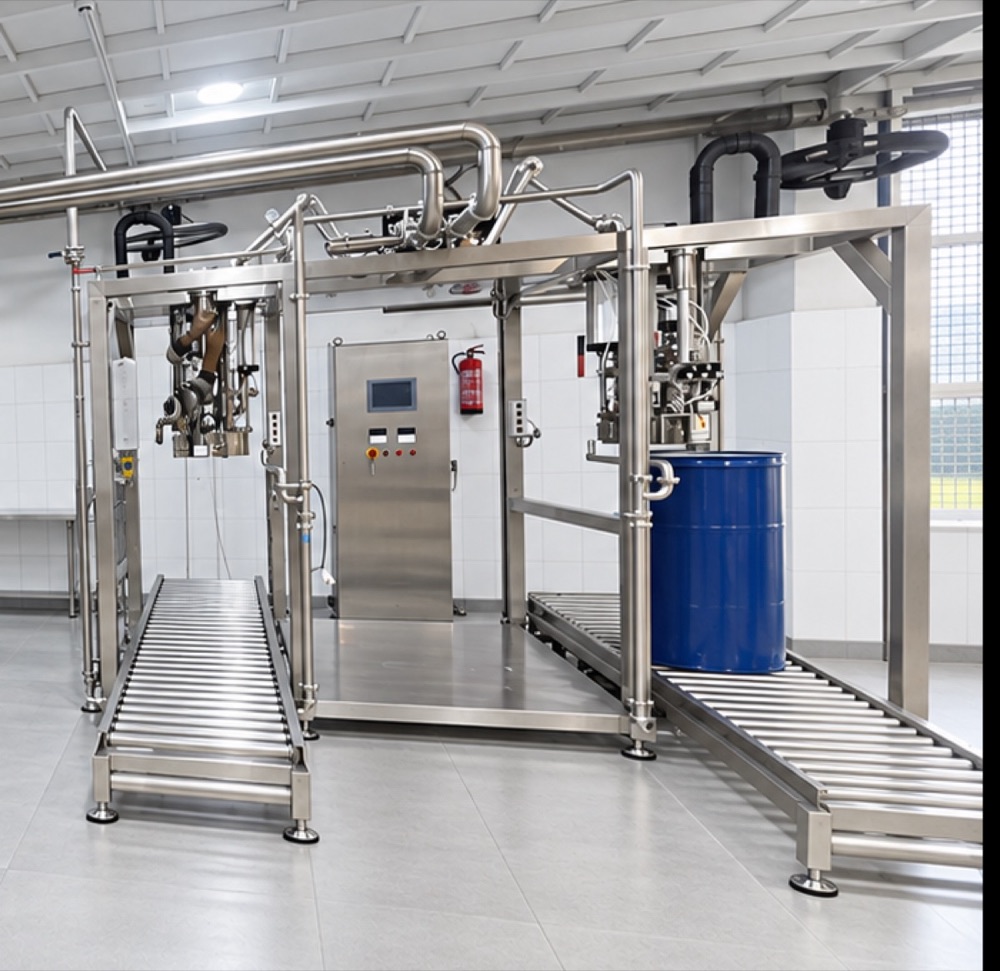
Manufacturer photographs show the filling head, drum or container handling and the connected cell. Final configuration, guarding and finish depend on the project.
Twin-head filling installation. Original equipment photograph, AI-retouched environment; source easireal.com.Close view of the filling station. Original equipment photograph, AI-retouched environment; source easireal.com.Drum roller conveyor arrangement. Photograph: EasyReal, source easireal.com.
SPECIFICATION REFERENCE
What the catalogue confirms — and what it does not.
Use these values to frame the enquiry. The offered specification, drawing and acceptance test govern the actual machine.
High-capacity aseptic bag filling system — published catalogue and configuration reference
Filling heads
Single or twin headModel-dependent
Bag formats
BIB 1–25 L · BID 200/220 L · BIC 1000/1500 LBy model and change parts
Bag mouth / fitment
1 in and 2 in (25 mm / 50 mm)Exact cap and neck drawing required
Metering
Flow meter or weighing systemModel and product dependent
Published metering reference
Coriolis flow meter ±0.3% · weighing ±5 g resolutionCatalogue reference; acceptance on your product
Steam
approx. 100 kg/h twinCatalogue reference at 0.6–0.8 MPa
Compressed air
approx. 0.06 m³/h twinCatalogue reference at 0.6–0.8 MPa
Installed power
2 / 4.5 / 9 kW by modelModel-dependent; confirm final electrical schedule
Control
PLC + HMI, recipe and sequence controlFinal I/O and recipe scope by project
Cleaning / sterilisation
CIP circuit and steam sterilisation of the filling interfaceSequence, validation and boundary by project
Bulk bag size
1000 L / 1500 L (AF4 family)BIC / IBC liner
Source: EasyReal AF-series aseptic bag filling catalogue. Catalogue values checked 22 October 2026. They are reference maxima for the model family, not a guarantee for a particular product, bag or line. Final model, scope and performance are confirmed in the offered specification.
PRODUCT FIT
Applications to review with this equipment.
Product names are a starting point. Viscosity, particles, temperature and the package interface determine whether a trial is needed.
The published catalogue maxima reach up to 12 t/h for the AF1D, AF3 and AF4 families. The actual sustained rate depends on the product, package, upstream supply, handling and cleaning window.
Can the system fill 1000 L bulk bags?
The AF4 family lists 1000 L and 1500 L BIC/IBC liner sizes. Confirm the exact bag, liner, fitment, container and filled load with the manufacturer.
Do I need two heads for 12 t/h?
Not automatically. The rate depends on the product and package cycle. A single head with a large fill may reach a high mass rate, while a small pack may need two positions to reach the finished-package rate.
How much buffer do I need?
The buffer depends on the upstream response time, filler demand and acceptable product holding time. It should be calculated with the line design, not guessed from the filler capacity.
Send the product, bag or container, target net mass, output and site conditions. We will confirm the model, scope and evidence needed for the next step.