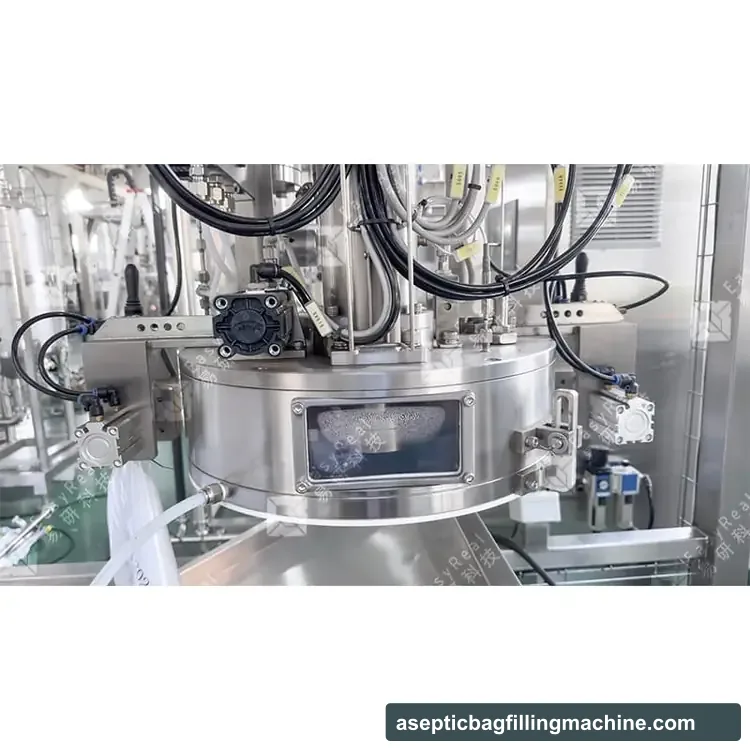
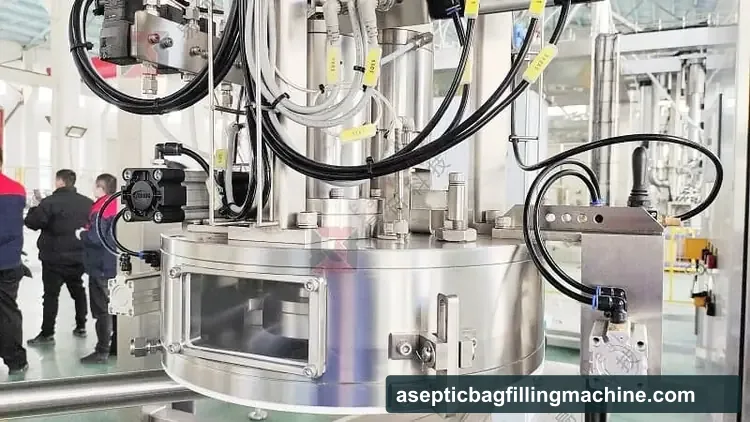
Filling-head assembly detail. Photograph: EasyReal, source easireal.com.Photograph supplied by the equipment manufacturer.
An aseptic filling head engages the bag fitment, protects the connection, admits product, stops the fill and allows the package to be closed. It is a mechanical, thermal and control interface, not a generic nozzle.
The head cannot make an incompatible bag compatible. The fitment drawing, cap geometry, bag support, product behaviour and pre-sterilisation method all have to be settled with it. The purpose of this page is to show what to specify, not to imply that every head fits every bag.
Interface1 in / 2 in bag mouth
ProtectionSteam barrier / steam treatment
FunctionOpen, fill, close, protect
ScopeMachine-specific component
01
What the head actually does
The head locates on the bag neck or fitment, opens the product path, controls the fill and protects the interface until the package is closed. Depending on the design, cap handling may be manual or integrated. The head also carries the product valve, steam or treatment connections, sensors and the surfaces that must be cleaned.
Ask for a section drawing or functional description of the offered head. A photograph shows the assembly, but it does not prove the fitment geometry, the valve size or the closure sequence.
The catalogue describes a steam-sterilised filling head and steam barrier for the filling interface. That is an equipment-interface treatment. It does not sterilise the food product, and it does not replace the upstream UHT or other validated product process.
Define the steam quality, pressure, temperature, exposure and monitoring point for the actual machine. The treatment must be compatible with the bag, cap and head materials. The acceptance evidence belongs in the commissioning and validation plan, not only in a product brochure.
Obtain the bag supplier, fitment part number, cap revision and drawing tolerances. Confirm how the head opens the cap, where the cap is held during filling, how the interface is protected and how the package is reclosed. A change part can adapt a nominal size, but it does not by itself establish sterility or closure performance.
If the line runs several bags, list every combination and the changeover task. The fastest head is not useful if a format change requires unverified adjustments inside the protected zone.
The product passage must suit the real product, not only a water-like test. For viscous or particulate products, confirm the valve bore, the final filling phase, the cleanability of the head and the response to a blockage. The smallest restriction may be in the pipework or fitment rather than the head.
Map the CIP circuit and the parts that are cleaned manually. Confirm how the head drains, how the cap area is accessed and how the pre-sterilisation sequence is verified after maintenance. Cleaning effectiveness and aseptic state are different objectives.
Send the bag or liner supplier, fitment and cap drawings, target net mass, product description at the filling condition, required output, existing filler or sterilizer, steam and air data, and the cleaning concept. If you have a sample bag and cap, ask whether a bench fit check is possible.
The answer should identify the head model or change parts, the interface treatment, the closure sequence and the acceptance test. A reply that quotes only a neck diameter has not matched the interface.
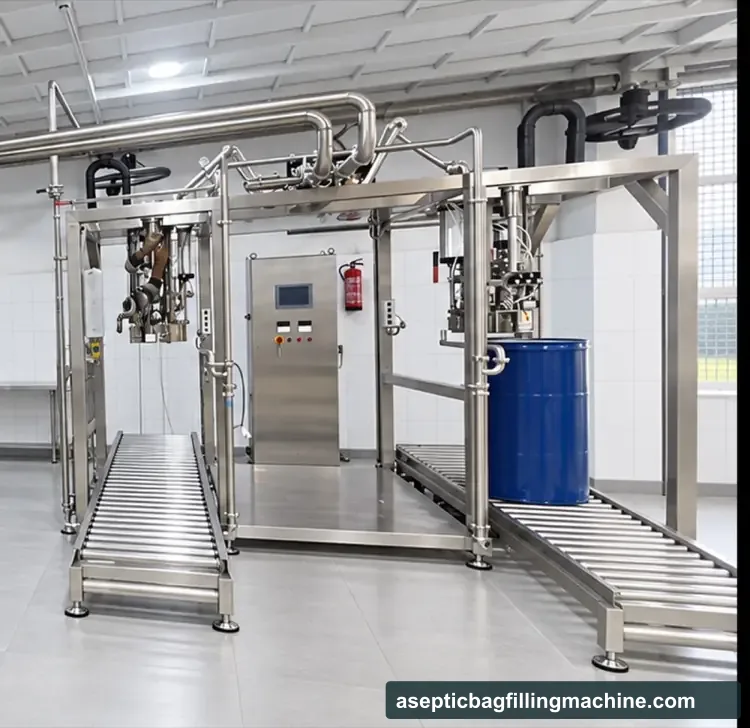
Manufacturer photographs show the filling head, drum or container handling and the connected cell. Final configuration, guarding and finish depend on the project.
Filling-head assembly detail. Photograph: EasyReal, source easireal.com.Filling-head close-up. Equipment photograph: EasyReal AF-series, source easireal.com.Close view of the filling station. Original equipment photograph, AI-retouched environment; source easireal.com.
SPECIFICATION REFERENCE
What the catalogue confirms — and what it does not.
Use these values to frame the enquiry. The offered specification, drawing and acceptance test govern the actual machine.
Aseptic filling head & fitment interface — published catalogue and configuration reference
Component type
Filling head and bag-fitment interfaceNot a standalone filling machine
Bag mouth
1 in and 2 in (25 mm / 50 mm)Exact fitment and cap drawing required
Interface treatment
Steam-sterilised filling head / steam barrierMethod, media, limits and validation by project
Product path
Product valve and protected filling passageSize and materials by model and product
Cap handling
Manual, semi-automatic or automated by machine scopeConfirm the offered sequence
Cleaning
CIP circuit and separate pre-sterilisation sequenceBoundary and acceptance by project
Construction
SUS304 / 316L construction referenced in the catalogueConfirm the wetted materials, finishes and elastomers for the offered head
Control
Integrated with the filler PLC/HMI sequenceI/O and recipe scope by project
Source: EasyReal AF-series aseptic bag filling catalogue. Catalogue values checked 25 October 2026. They are reference maxima for the model family, not a guarantee for a particular product, bag or line. Published dimensions are the machine footprint and exclude conveyors, service clearance and site-specific guarding. Final model, scope and performance are confirmed in the offered specification.
PRODUCT FIT
Applications to review with this equipment.
Product names are a starting point. Viscosity, particles, temperature and the package interface determine whether a trial is needed.
A filling head is normally matched to a filling machine, its controls, guards, steam supply and package handling. It is not a universal standalone upgrade. Send the existing machine details and fitment drawing so the mechanical and control interfaces can be checked.
Does the steam barrier sterilise the product?
No. It treats the filling interface. Product sterilisation is an upstream process such as UHT or another validated treatment. The filler protects the treated product and manages the fill-and-close sequence.
Will a 2 in head fit every 2 in bag?
No. A nominal 2 in mouth does not define the thread, flange, cap, tolerance or opening method. The exact fitment and cap drawing are required, and a change part may be needed.
How do I verify the aseptic interface?
The supplier and user should define the interface treatment, critical limits, monitoring, maintenance checks and acceptance evidence for the actual machine, package and process. A generic certificate or brochure claim is not a substitute.
Send the product, bag or container, target net mass, output and site conditions. We will confirm the model, scope and evidence needed for the next step.