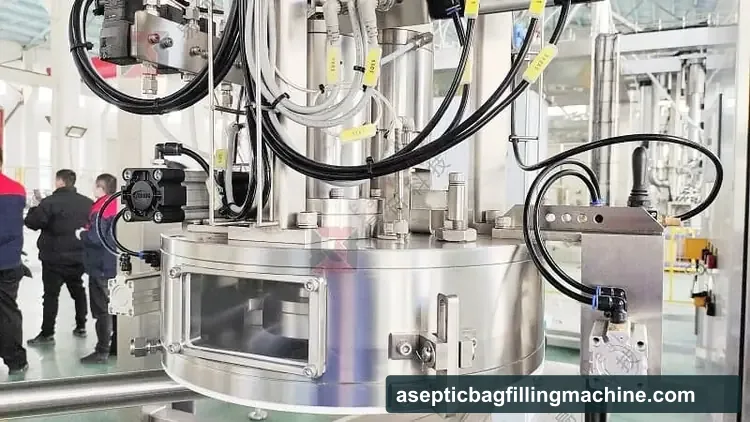
Build the plan from the actual machine
Use the supplier manual and the site risk assessment to set intervals; do not copy a generic checklist from another line. Divide tasks into production checks, planned maintenance, cleaning and sterilization verification, and calibration. Record who is allowed to release the machine after each task. The aseptic filler should not be restarted on an informal verbal handover.
Daily and shift checks
Confirm the correct recipe, bag and fitment, steam and air availability, guard and interlock status, and the condition of the filling head before production. Check that the cap handling parts match the bag and that the waste or reject route is clear. At the end of the run, record the actual net-fill results, rejects, alarms and any intervention in the protected zone. A clean-looking machine is not evidence that the interface treatment worked.
Steam, air and the sterile boundary
Inspect the steam and air supply at the point of use, not only at the plant gauge. Confirm pressure, quality, drainage and the condition of hoses, filters and valves. A stable utility supply is part of the interface treatment; a fluctuating supply can invalidate the sequence even when the PLC reports a completed cycle. Define the alarm and stop response for a utility deviation, and isolate the product path before maintenance.
Net-fill drift and metering checks
If the net fill drifts, first check the product and package: density, temperature, viscosity, bag tare and support stability. Then check the meter or load cells, the inlet pressure, the valve cut-off and the filling-head condition. A meter calibration does not correct an unstable product supply or a bag that moves during filling. Use a defined sample and acceptance method, and keep the raw results with the batch record.
Cap handling, seals and change parts
Inspect cap pick-up, opening, holding and replacement for wear and product build-up. Confirm the correct change part for each bag and cap revision. Worn seals or a damaged head can create a leak path or a closure defect that is not visible from the outside. Keep a traceable spare-parts list and define which parts may be replaced by the operator and which require engineering release.
A simple fault-finding sequence
First stop and isolate the machine, then identify whether the fault is product supply, package, interface treatment, metering, closure or handling. Preserve the alarm and batch data before clearing it. Do not bypass an interlock or re-run a failed sterilization step without an approved procedure. After the repair, verify the affected function and record the restart evidence before releasing product.
EQUIPMENT TO COMPARE
Machines that fit this selection.
AF1S single-head bag-in-drum filler
A single filling position for 200 L class aseptic bags in drums. The AF1S is the reference model when one head, one drum station and a straightforward load–fill–close cycle fit your production window.
Review the model ↗AF2SAF2S single-head bag-in-box filler
A compact single-head model for 1–25 L aseptic bags in boxes. The AF2S is the starting point when retail and food-service pack sizes, quick changeovers and a small footprint matter more than bulk drum output.
Review the model ↗AutomationHigh-capacity aseptic bag filling system
High capacity is a system property. The filler, upstream supply, drum or bin logistics, weighing and cleaning must be designed for the same sustained rate.
Review the model ↗PRACTICAL ANSWERS
Frequently asked questions
How often should the filling head be serviced?
The interval depends on the machine design, product, running hours, cleaning chemicals and supplier instructions. Set it from the manual and a site risk assessment; do not use a universal interval from another line.
Can the operator replace filling-head seals?
Only if the supplier and site procedures authorize it, with the correct parts and post-maintenance checks. Work inside the aseptic boundary should have a defined release step.
What causes net-fill variation?
Product density and temperature, bag tare, support movement, inlet pressure, valve cut-off, meter calibration and the sampling method can all contribute. Diagnose in that order before changing the setpoint.
What records should be kept?
Keep maintenance tasks, parts, calibration, cleaning and sterilization cycle records, alarms, deviations, net-fill results and release signatures. The exact retention period depends on your food-safety and customer requirements.