Bulk bags change the scale of every interface: head reach, liner support, filled load, weighing, container movement and the time needed to fill one package.
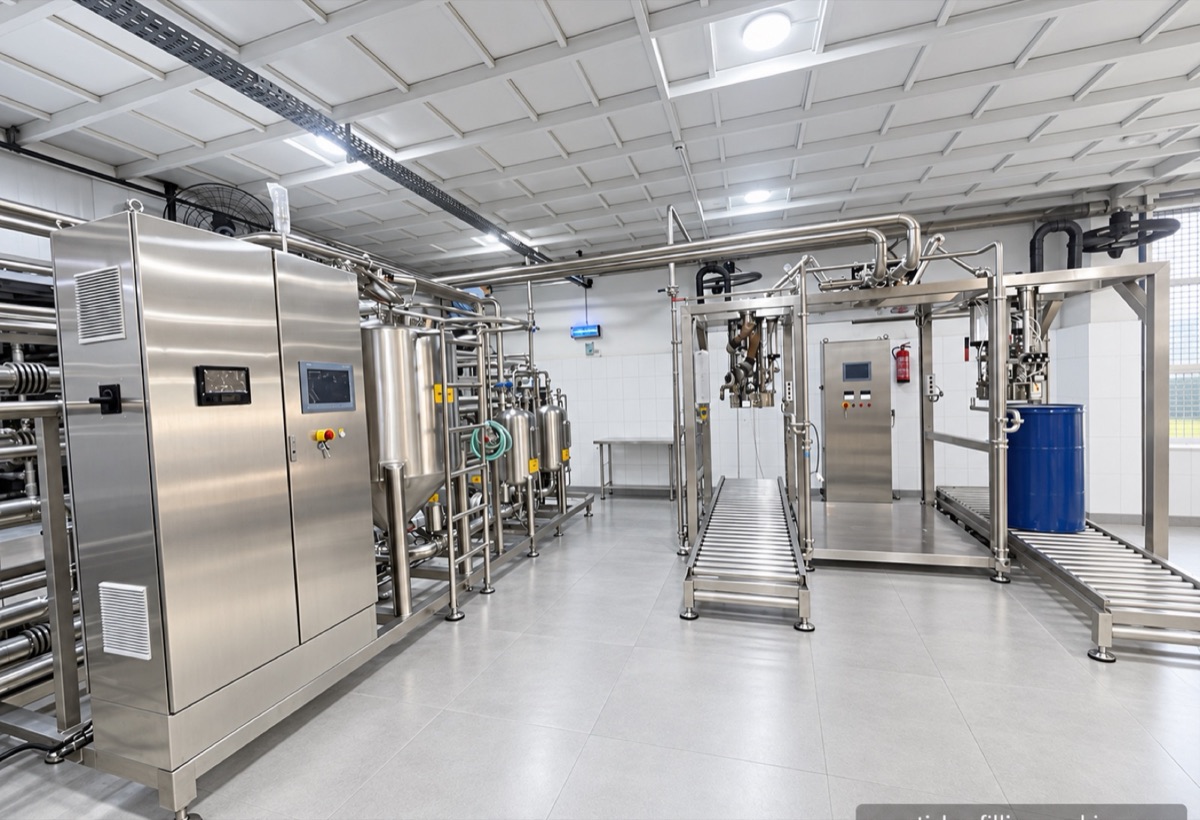
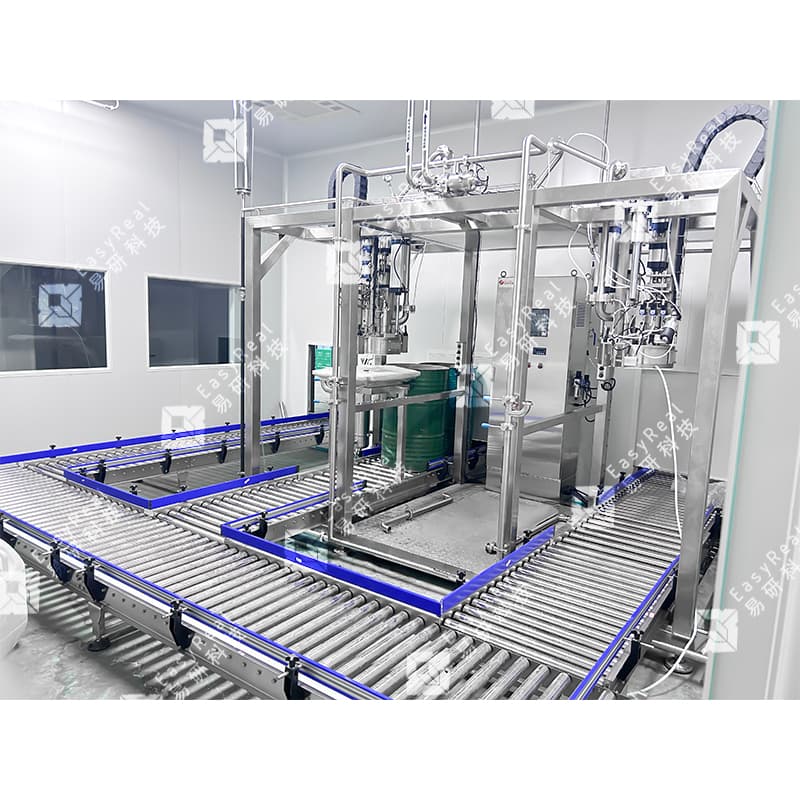
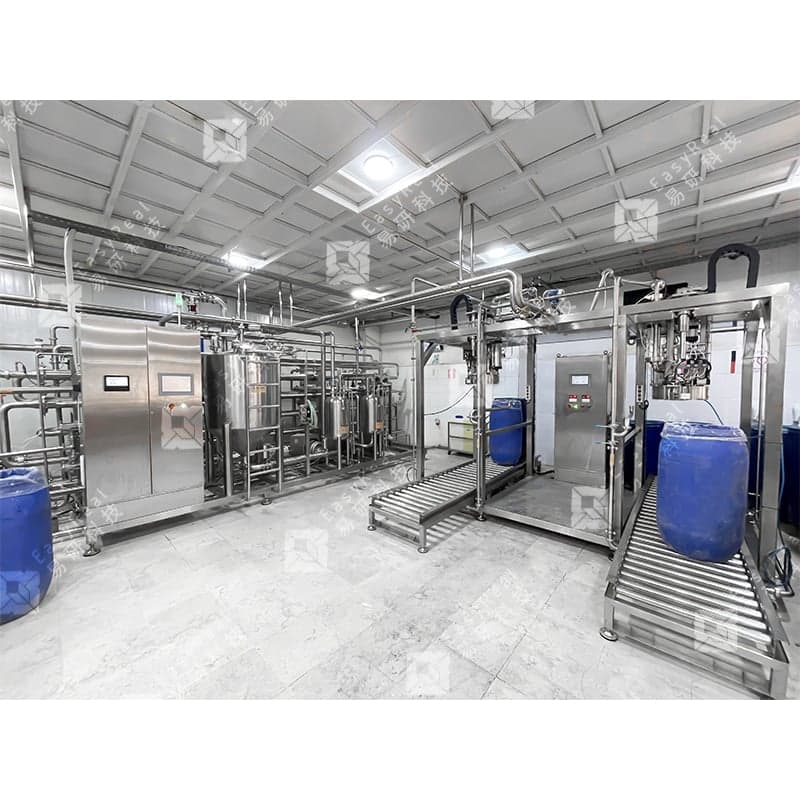
Twin-head filling installation. Original equipment photograph, AI-retouched environment; source easireal.com.Photograph supplied by the equipment manufacturer.
A 1000 L aseptic bulk bag filling machine fills a large flexible liner or bulk bag, usually supported by an IBC or a dedicated frame. The package is heavy, the fill takes time and the container movement becomes a major part of the cycle.
The AF4 family is the bulk configuration in the published catalogue, covering 200/220 L drums and 1000/1500 L bulk bags, with single or twin heads and up to 12 t/h. The exact model, head reach and support arrangement must be confirmed against your container.
Package1000 L / 1500 L
FamilyAF4 BIC / IBC
Published max.up to 12 t/h
HandlingBulk container
01
Container and liner geometry
Record the IBC or frame dimensions, the liner installation method, the fitment position and the head clearance. The filling head must reach the fitment without stretching the liner or trapping the bag. Confirm the empty and filled load and the lifting or conveyor method.
A 1000 L nominal volume is not a 1000 kg guarantee. Product density, target net mass, ullage and liner shape determine the fill. Check the filled load against the floor, frame, conveyor and weighing platform.
A 1000 L fill can take a significant part of the cycle. The upstream supply must deliver the required flow for the whole fill without exceeding the product’s allowable holding time or the filler inlet window. A buffer may be needed to decouple the sterilizer from the filling cycle.
If the product is viscous, the pressure loss and the final filling phase can extend the cycle. Do not select the model from a headline t/h figure alone; calculate the fill time from the actual mass flow and add the handling steps.
Bulk filling usually uses a weighing system, but the platform and support must handle the full load safely. Confirm the tare, calibration, load cell protection and the effect of the filling connection on the measurement.
The liner must be supported so that the product weight is carried by the container or frame, not the fitment. The filling head should follow the fitment or be isolated from the load to avoid damaging the bag neck.
Large containers are difficult to move and clean around. Plan the CIP return, the access to the head and the draining of the product path. Confirm how a partially filled or rejected bulk bag is isolated and handled.
If the line switches between 200 L drums and 1000 L bulk bags, confirm the change parts, head reach, support and weighing range. A multi-format model may be possible, but it should be verified against both packages.
Manufacturer photographs show the filling head, drum or container handling and the connected cell. Final configuration, guarding and finish depend on the project.
What the catalogue confirms — and what it does not.
Use these values to frame the enquiry. The offered specification, drawing and acceptance test govern the actual machine.
1000 L aseptic bulk bag filling machine — published catalogue and configuration reference
Typical bag size
1000 L / 1500 LBIC / IBC liner
Reference family
AF4S / AF4D
Published maximum
up to 12 t/h
Installed power
4.5 kW single · 9 kW twin
Metering
Weighing system or flow meter
Fitment
1 in and 2 in (25 mm / 50 mm)Confirm the bulk fitment drawing
Steam
Confirm for the AF4 configuration
Air
Confirm for the AF4 configuration
Filling interface
Steam-sterilised head; CIP/SIP integrated
Dimensions
Layout-specific; confirm head reach and container envelope
Source: EasyReal AF-series aseptic bag filling catalogue. Catalogue values checked 22 October 2026. They are reference maxima for the model family, not a guarantee for a particular product, bag or line. Final model, scope and performance are confirmed in the offered specification.
PRODUCT FIT
Applications to review with this equipment.
Product names are a starting point. Viscosity, particles, temperature and the package interface determine whether a trial is needed.
It is a large flexible liner or bulk bag, often supported by an IBC or frame, filled with a treated food product under an aseptic interface. The exact construction and fitment depend on the packaging supplier.
Which model fills 1000 L bulk bags?
The published AF4 family covers BIC/IBC liner sizes of 1000 L and 1500 L, in single or twin-head configurations. Confirm the model, head reach and support with the manufacturer.
How long does a 1000 L fill take?
It depends on the product mass flow, pressure loss, target mass and the final filling phase. Calculate the fill time from the actual flow and add container handling, closure and inspection. Do not use a headline t/h figure as the cycle time.
Can the same machine fill drums and bulk bags?
A multi-format AF4 configuration is listed for BID and BIC, but the change parts, support, head reach and weighing range must be verified for both. Do not assume interchangeability from the model name alone.
Send the product, bag or container, target net mass, output and site conditions. We will confirm the model, scope and evidence needed for the next step.