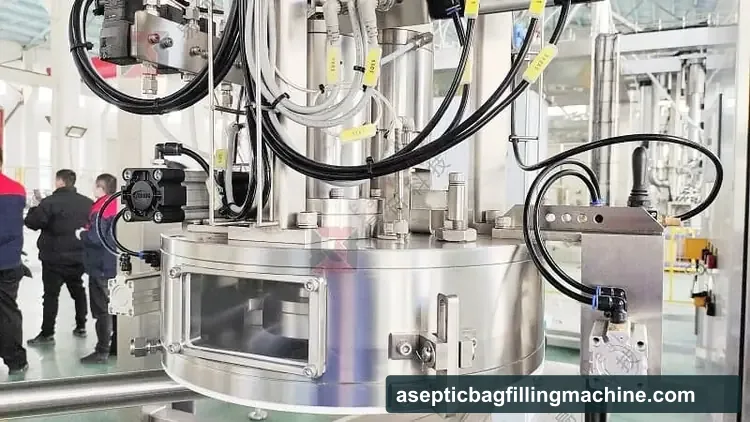
Bag-in-box: small packs, high handling share
Bag-in-box commonly covers 1–25 L. The bag may be filled before insertion into the box or while supported by it, and those arrangements need different bag presentation and support. At small fill masses, fitment connection, closure inspection and boxing can take more of the cycle than the fill. A twin-head machine helps only if those tasks can overlap. The box is not a substitute for a correct bag support; the product weight must not load the fitment.
Bag-in-drum: the 200 L workhorse
Bag-in-drum typically uses 200 L or 220 L bags supported by a steel or plastic drum. The drum is the handling unit; the bag is the product-contact package. Record the drum diameter, height, tare mass, pallet pattern and filled mass. A roller conveyor, positive stop and weighing platform are part of the filling cell, not optional layout details. One drum fill takes longer than one small bag fill, but the mass per package is much higher.
Bag-in-bin or IBC liner: bulk handling
A 1000 L or 1500 L liner in an IBC or frame changes the scale of every interface. Head reach, liner installation, full-load weighing, floor loading and container movement become central. A 1000 L nominal volume is not a 1000 kg guarantee; density, ullage and target mass determine the fill. The container must be stable during filling, and the site must be able to move and store the filled load safely.
Compare the complete package cycle
For each format, list the package rate, net mass, loading method, fitment connection, fill time, closure, inspection, removal and cleaning. Convert the rates to the same basis, such as tonnes per shift or finished packages per hour, and include changeover and planned stops. A 3 t/h small-bag line and a 6 t/h drum line are not interchangeable just because both figures appear in a catalogue.
Fitment and cleaning do not transfer automatically
A 1 in or 2 in mouth is a nominal dimension, not a compatibility statement. The fitment thread, flange, cap, tolerances and opening method must match the filling head and closure sequence. Cleaning also changes with the package: a small-bag head, a drum station and a bulk liner support expose different surfaces and residues. Define the CIP/SIP boundary and changeover verification for each format before sharing one machine.
EQUIPMENT TO COMPARE
Machines that fit this selection.
AF2S single-head bag-in-box filler
A compact single-head model for 1–25 L aseptic bags in boxes. The AF2S is the starting point when retail and food-service pack sizes, quick changeovers and a small footprint matter more than bulk drum output.
Review the model ↗AF1SAF1S single-head bag-in-drum filler
A single filling position for 200 L class aseptic bags in drums. The AF1S is the reference model when one head, one drum station and a straightforward load–fill–close cycle fit your production window.
Review the model ↗Bulk format1000 L aseptic bulk bag filling machine
Bulk bags change the scale of every interface: head reach, liner support, filled load, weighing, container movement and the time needed to fill one package.
Review the model ↗PRACTICAL ANSWERS
Frequently asked questions
Can one machine fill box, drum and bin formats?
A published multi-format family such as AF3 or AF4 may cover more than one package range, but the head, support, weighing range, change parts and clearance must be verified for each. Do not assume interchangeability from the family name.
Which format is cheapest per litre?
The package, labour, storage, transport and filling cycle all contribute. A bulk liner may reduce packaging labour but requires different handling; a small bag may cost more per litre but serve a different market. Compare total cost per finished package.
Does a bigger bag always mean higher output?
No. A large fill can take longer and container movement may dominate. Output is a complete-cycle property, not a bag-size property.
Where does the filling machine stop and the packaging line start?
That boundary must be written into the scope. Boxing, case packing, palletising, labelling and storage may be separate machines or manual tasks. The filler scope should state exactly what it hands over.