Configuration & engineering scope
Twin-head aseptic bag filler
Two filling positions considered together with product supply, package handling and the control sequence.
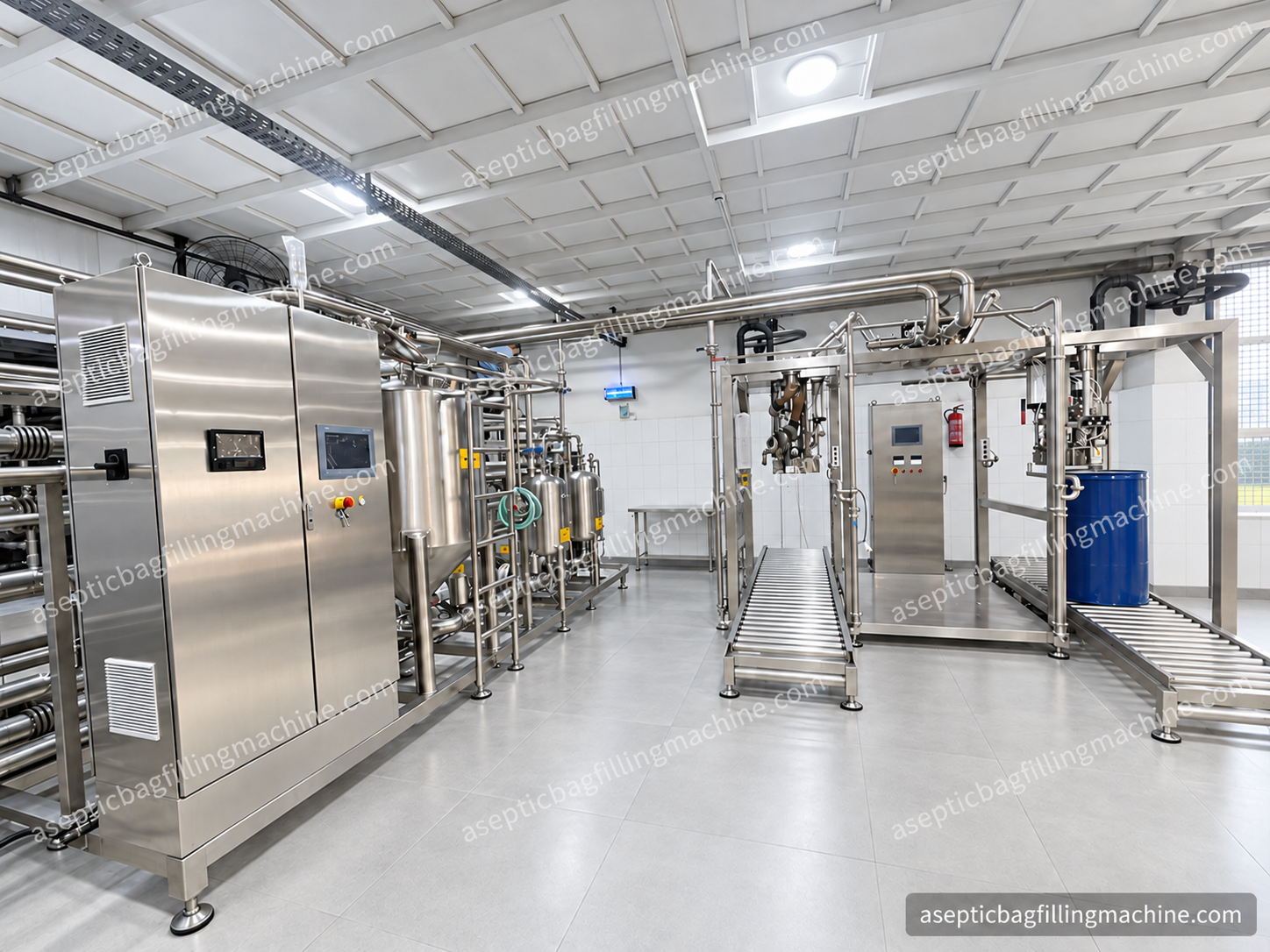
Functional assembly context. This drawing does not identify a supplied model or its dimensions.
The operating decision
Two heads may allow package-handling steps to overlap, depending on the actual design. Confirm whether heads fill simultaneously or alternate, and which product, weighing and cleaning circuits are shared.
A second head does not by itself double output. Shared flow, operator tasks, container movement and downtime may remain the limiting steps.
Include in your enquiry ↗Original equipment photography, AI-retouched · final equipment depends on the project
Where this configuration fits
Review two positions when overlapping package handling could help the production cycle. Confirm which tasks overlap, whether heads alternate or fill simultaneously, and which services are shared.
Package options to assess
Bag-in-drum, bag-in-box and bulk-bin formats each require a verified fitment match, suitable package support and an agreed weighing and handling arrangement.
Compare single and twin heads →Information that defines the specification
Shared product and cleaning circuits
Operator access and container collision envelope
Performance with one head unavailable
Use the actual bag and product to establish the final equipment schedule. Model identity, fill mass range, cycle rate, accuracy test and utility conditions belong together in the proposal.
CATALOGUE REFERENCES
Technical parameters.
A clear starting point.
Published catalogue values help identify a family. Actual throughput depends on product flow, viscosity, bag size and the full loading, filling and closing cycle. Photo appearance alone does not identify a model.
| Model | Heads | Package | Bag size | Published maximum throughput | Listed power |
|---|---|---|---|---|---|
| AF1S | Single | Bag-in-drum | 200–220 L | up to 6 t/h | 1 kW |
| AF1D | Twin | Bag-in-drum | 200–220 L | up to 12 t/h | 2 kW |
| AF2S | Single | Bag-in-box | 1–25 L | up to 3 t/h | 1 kW |
| AF2D | Twin | Bag-in-box | 1–25 L | up to 5 t/h | 2 kW |
Source: published equipment catalogue, checked 12 October 2026. These are catalogue maxima, not a performance guarantee for your material. Confirm fitment drawing, utilities, net-fill accuracy and acceptance method in the offered specification.
Product fit
Assess juices, fruit purées, concentrates and compatible food ingredients. Provide viscosity at filling temperature, fibre and particle size; confirm pumpability and passage through the actual fitment.
Configuration advantages
A single head offers a direct handling sequence. Twin heads may overlap package handling where the design allows. Metering, weighing, controls and cleaning are specified together.
Hygienic process
The filler protects the treated product at the package interface. Product sterilization is upstream; validate product treatment, sterile transfer, bag handling and closure as one system.
Cleaning and acceptance are part of the scope.
Identify product-contact surfaces, removable parts, manual access, cleaning return and the agreed pre-sterilization boundary. Acceptance compares the agreed configuration under the specified product and package conditions.
Cleaning and pre-sterilization →Factory and site acceptance →