A semi-automatic cell keeps the operator in the package-handling loop while automating the protected fill and closure. It can be the practical choice for smaller batches, multiple formats and staged investment.
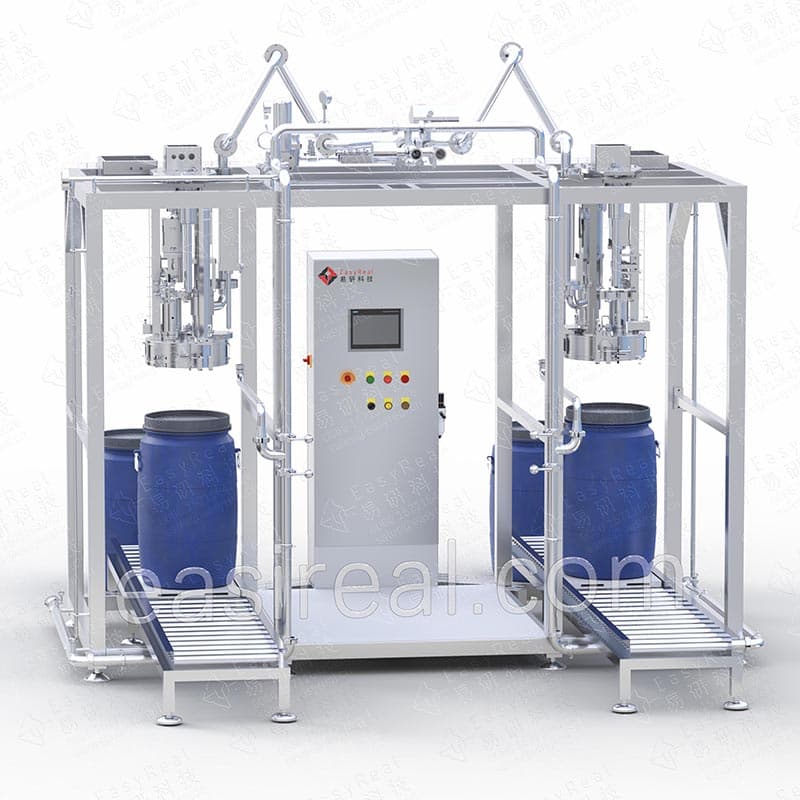
Twin-head bag-in-drum configuration. Equipment photograph: EasyReal, source easireal.com.Photograph supplied by the equipment manufacturer.
A semi-automatic aseptic bag filler still uses a protected filling head, metering and a controlled closure, but the operator presents the bag or drum and initiates each cycle. This can reduce the machine scope and capital cost while keeping the aseptic interface under control.
The trade-off is labour and cycle consistency. The operator’s loading, fitment connection and removal time become part of every cycle, so the ergonomics and the handling layout matter as much as the filler itself.
PlatformAF-series
FormatsBIB · BID
OperationOperator-loaded
MeteringFlow or weighing
01
Where semi-automatic operation fits
Consider a semi-automatic cell when production runs are shorter, the pack range changes frequently, or the investment needs to be staged. It can also suit a pilot line or a factory where drum logistics are already manual.
Do not choose it only because the headline price is lower. Include the operator cost, the achievable cycle, the rejection risk and the cost of adding automation later. A semi-automatic cell that cannot keep up is expensive in a different way.
Define the operator tasks: bag pick-up, fitment inspection, connection to the head, cycle start, closure inspection and removal. Each task needs a safe, repeatable position. The filling head should not be loaded by the bag or drum weight.
Training and access control matter. The sequence should prevent a cycle from starting with the guard open or the fitment not seated. Confirm the interlocks and the response to an operator error.
A semi-automatic machine can use flow-meter or weighing control, depending on the model and package. The metering choice should follow the fill target and product behaviour, not the automation level. A manual load does not make a flow meter suitable for a highly variable product.
For multiple formats, confirm the change parts, recipe changes and cleaning steps. The fastest machine is not useful if a format change takes a full shift.
If future volumes may grow, ask whether the proposed platform can add conveyors, automatic cap handling or a second head later. A modular path is better than a dead-end design, but only if the future scope is realistic.
Record the current and future requirements in the enquiry. The supplier can then state which parts are upgradeable and which would require a different machine.
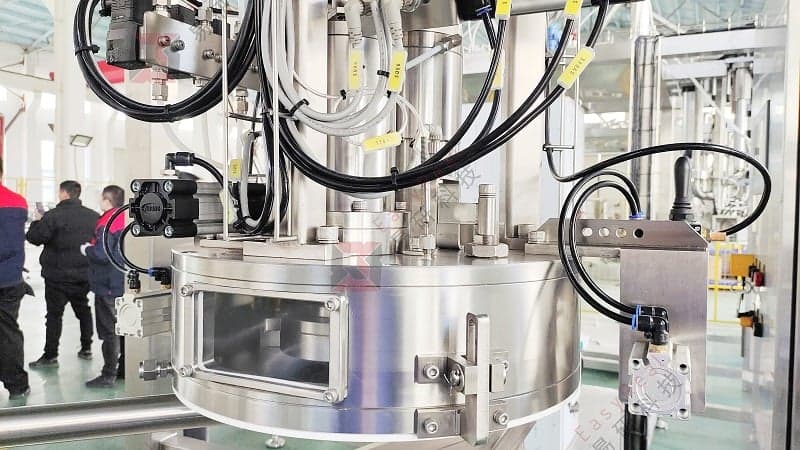
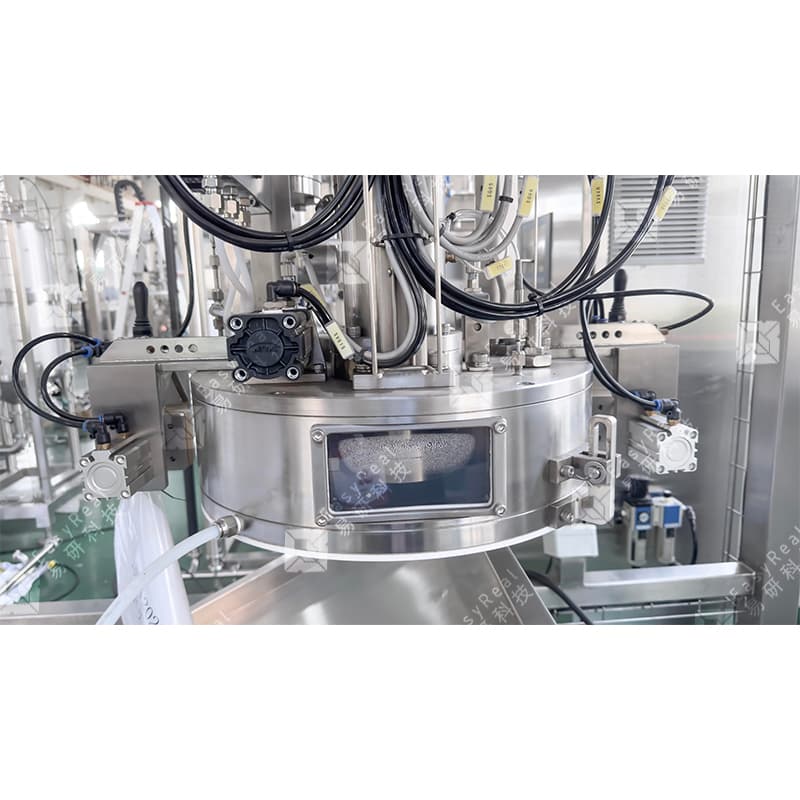
Manufacturer photographs show the filling head, drum or container handling and the connected cell. Final configuration, guarding and finish depend on the project.
What the catalogue confirms — and what it does not.
Use these values to frame the enquiry. The offered specification, drawing and acceptance test govern the actual machine.
Semi-automatic aseptic bag filler — published catalogue and configuration reference
Filling heads
Single or twin headModel-dependent
Bag formats
BIB 1–25 L · BID 200/220 L · BIC 1000/1500 LBy model and change parts
Bag mouth / fitment
1 in and 2 in (25 mm / 50 mm)Exact cap and neck drawing required
Metering
Flow meter or weighing systemModel and product dependent
Published metering reference
Coriolis flow meter ±0.3% · weighing ±5 g resolutionCatalogue reference; acceptance on your product
Steam
approx. 50 kg/h single · 100 kg/h twinCatalogue reference at 0.6–0.8 MPa
Compressed air
approx. 0.04 m³/h single · 0.06 m³/h twinCatalogue reference at 0.6–0.8 MPa
Installed power
1 / 2 kW by modelModel-dependent; confirm final electrical schedule
Control
PLC + HMI, recipe and sequence controlFinal I/O and recipe scope by project
Cleaning / sterilisation
CIP circuit and steam sterilisation of the filling interfaceSequence, validation and boundary by project
Source: EasyReal AF-series aseptic bag filling catalogue. Catalogue values checked 22 October 2026. They are reference maxima for the model family, not a guarantee for a particular product, bag or line. Final model, scope and performance are confirmed in the offered specification.
PRODUCT FIT
Applications to review with this equipment.
Product names are a starting point. Viscosity, particles, temperature and the package interface determine whether a trial is needed.
It can be, if the filling head, package interface, sterilisation sequence and closure are designed and operated as an aseptic system. The automation level is separate from the aseptic design.
How many bags per hour can an operator handle?
That depends on the pack size, ergonomics, fitment, filling time and inspection steps. Measure the complete manual cycle; do not use a filling-phase figure as the bag rate.
Can a semi-automatic machine be upgraded later?
Some platforms can add conveyors or handling modules, but not all. Ask specifically which future scope is supported and which requires a different machine.
Is semi-automatic cheaper?
The machine scope is often lower, but the total cost includes labour, changeover, rejects and future upgrades. Compare the full cost per finished package, not only the equipment price.
Send the product, bag or container, target net mass, output and site conditions. We will confirm the model, scope and evidence needed for the next step.