Small packs change the filling problem. At 1–25 L, the bag presentation, fitment connection, closure and boxing can take more time than the product fill itself.
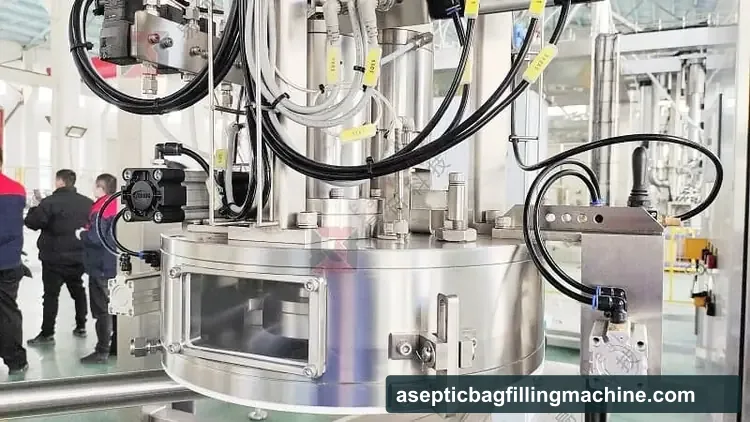
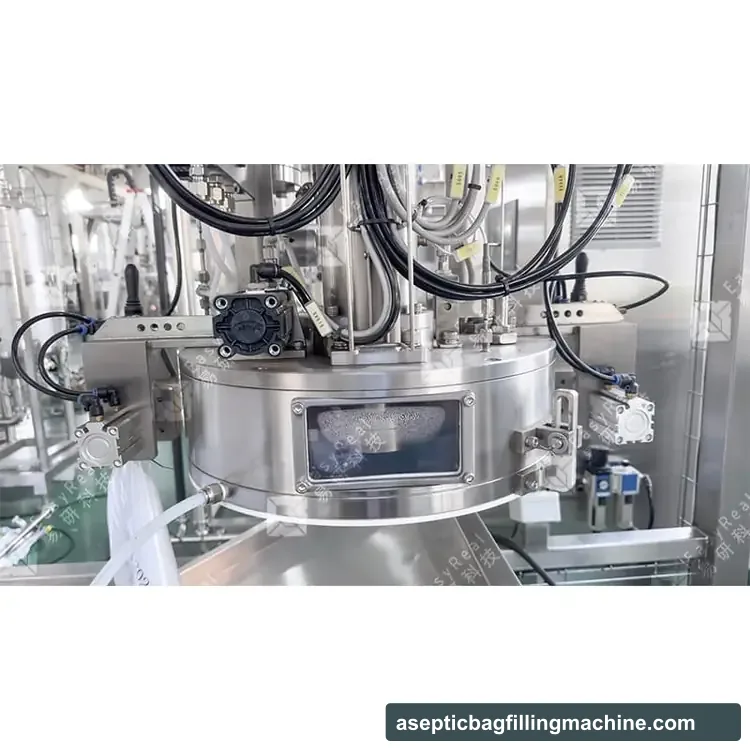
Filling-head close-up. Equipment photograph: EasyReal AF-series, source easireal.com.Photograph supplied by the equipment manufacturer.
A small aseptic bag filling machine fills pre-sterilised 1–25 L bags, usually supported in a box or transferred to one after filling. The AF2S single-head and AF2D twin-head models are the published bag-in-box references in the AF family.
Small packs are often treated as a miniature version of a drum filler. In practice the handling ratio is different: more packages are needed for the same mass, and each one needs a fitment connection, fill, closure and inspection. That is why a published t/h figure is a poor substitute for a finished-box cycle.
Package1–25 L bag-in-box
Reference modelsAF2S / AF2D
Published max.3 t/h single · 5 t/h twin
MeteringFlow meter
01
Where a small bag filler fits
The 1–25 L range covers foodservice packs, ingredient samples, retail and export units. A single-head AF2S can suit a defined production window or a product range that changes often. The AF2D adds a second position when bag supply, boxing and operator work can keep both heads fed.
Do not select the model from pack size alone. Record the target bags per minute or boxes per shift, the product condition, the bag and fitment, and the downstream boxing or case-packing arrangement.
At small fill masses, the non-filling steps dominate. Include bag pick-up, fitment inspection, connection, steam treatment, fill, final cut-off, cap replacement, closure inspection, boxing and removal. A twin-head layout only helps where those tasks can genuinely overlap.
Ask for a cycle breakdown with the proposed bag, box and operator arrangement. If the supplier quotes only a filling flow, the finished-box rate remains unverified.
The exact bag supplier, fitment part number, cap geometry and drawing revision are part of the machine specification. A 1 in or 2 in nominal mouth does not prove that a head, change part and closure sequence are compatible.
The bag must be supported so that the product weight is not carried by the fitment or the filling head. Confirm whether the bag is filled before box insertion or while supported by the box, and plan the boxing sequence around the aseptic connection.
The published AF2 configuration uses a flow meter. Its reference accuracy is not the same as the finished-pack result: product density, flow stability, the final filling phase, valve response and the sampling method all contribute. For products with particles or high viscosity, confirm the valve path and a representative trial.
If your product varies in density or the fill target is very small, discuss whether a different metering approach is available. Do not assume that a flow meter listed for juice is automatically suitable for a fibrous purée or a sauce with particles.
The AF2 references use approximately 50 kg/h steam and 0.04 m³/h air for a single head, and 100 kg/h steam and 0.06 m³/h air for a twin head at 0.6–0.8 MPa. Confirm the final demand schedule for the cleaning and sterilisation sequence, not only the filling phase.
The filler protects the bag interface and manages the fill-and-close cycle. Product sterilisation is upstream. Define the CIP/SIP boundary, the closure inspection and the handover to boxing before comparing quotations.
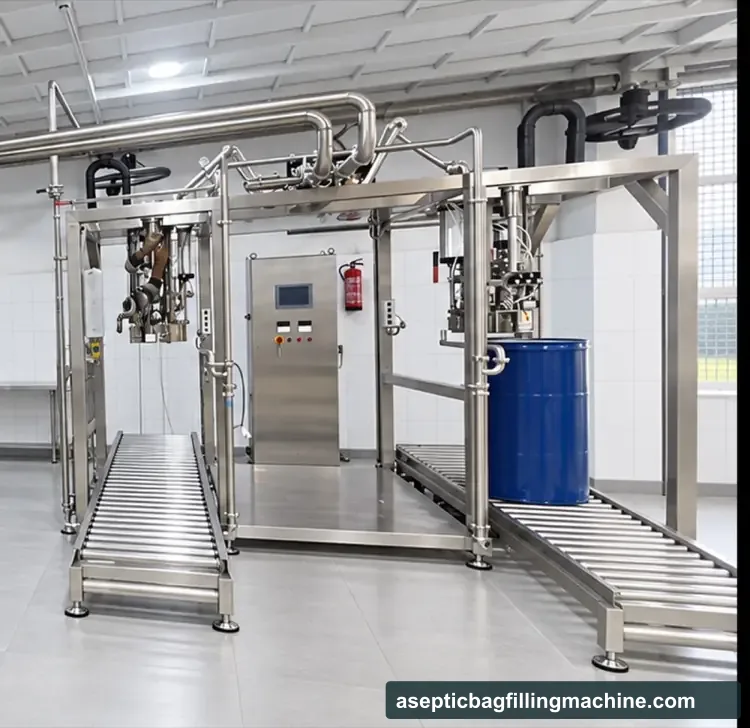
Manufacturer photographs show the filling head, drum or container handling and the connected cell. Final configuration, guarding and finish depend on the project.
Filling-head close-up. Equipment photograph: EasyReal AF-series, source easireal.com.Filling-head assembly detail. Photograph: EasyReal, source easireal.com.Close view of the filling station. Original equipment photograph, AI-retouched environment; source easireal.com.
SPECIFICATION REFERENCE
What the catalogue confirms — and what it does not.
Use these values to frame the enquiry. The offered specification, drawing and acceptance test govern the actual machine.
Small aseptic bag filling machine (1–25 L) — published catalogue and configuration reference
Bag format
Bag-in-box (BIB)
Bag size
1–25 LWorking range narrower by bag drawing and box
Reference models
AF2S single head · AF2D twin head
Published maximum throughput
up to 3 t/h single · up to 5 t/h twinCatalogue reference
Installed power
1 kW single · 2 kW twin
Metering
Flow meterPublished AF2 configuration
Bag mouth / fitment
1 in and 2 in (25 mm / 50 mm)Exact neck, cap and drawing revision required
Filling interface
Steam-sterilised filling head; CIP/SIP integrated
Dimensions (W × D × H)
AF2S 1700 × 1200 × 2800 mm · AF2D 1700 × 1700 × 2800 mmCatalogue footprint; excludes conveyor and service clearance
Steam / air
Approx. 50/100 kg/h steam · 0.04/0.06 m³/h air at 0.6–0.8 MPaSingle/twin reference; confirm by sequence
Net-fill accuracy
Catalogue reference: flow meter ±0.3%Finished-pack acceptance on your product and package
Source: EasyReal AF-series aseptic bag filling catalogue. Catalogue values checked 25 October 2026. They are reference maxima for the model family, not a guarantee for a particular product, bag or line. Published dimensions are the machine footprint and exclude conveyors, service clearance and site-specific guarding. Final model, scope and performance are confirmed in the offered specification.
PRODUCT FIT
Applications to review with this equipment.
Product names are a starting point. Viscosity, particles, temperature and the package interface determine whether a trial is needed.
The published AF2 family range is 1–25 L. The practical lower limit depends on the bag, fitment, pump and metering arrangement, so confirm the exact bag and target fill rather than relying on the family range.
Is a twin-head machine twice as fast?
Not necessarily. At 1–25 L, bag presentation, fitment handling, closure and boxing can limit the finished-box rate. Compare a complete cycle with the same bag and staffing assumptions.
Can it fill viscous sauces or purées?
The flow-meter configuration is published for the AF2 range, but suitability for a viscous or particulate product requires a review of the valve path, product behaviour and a representative trial. Do not infer compatibility from a juice application.
Does the filler sterilise the product?
No. Product sterilisation is an upstream process. The filler protects the treated product at the bag interface, fills and closes the package.
Send the product, bag or container, target net mass, output and site conditions. We will confirm the model, scope and evidence needed for the next step.